

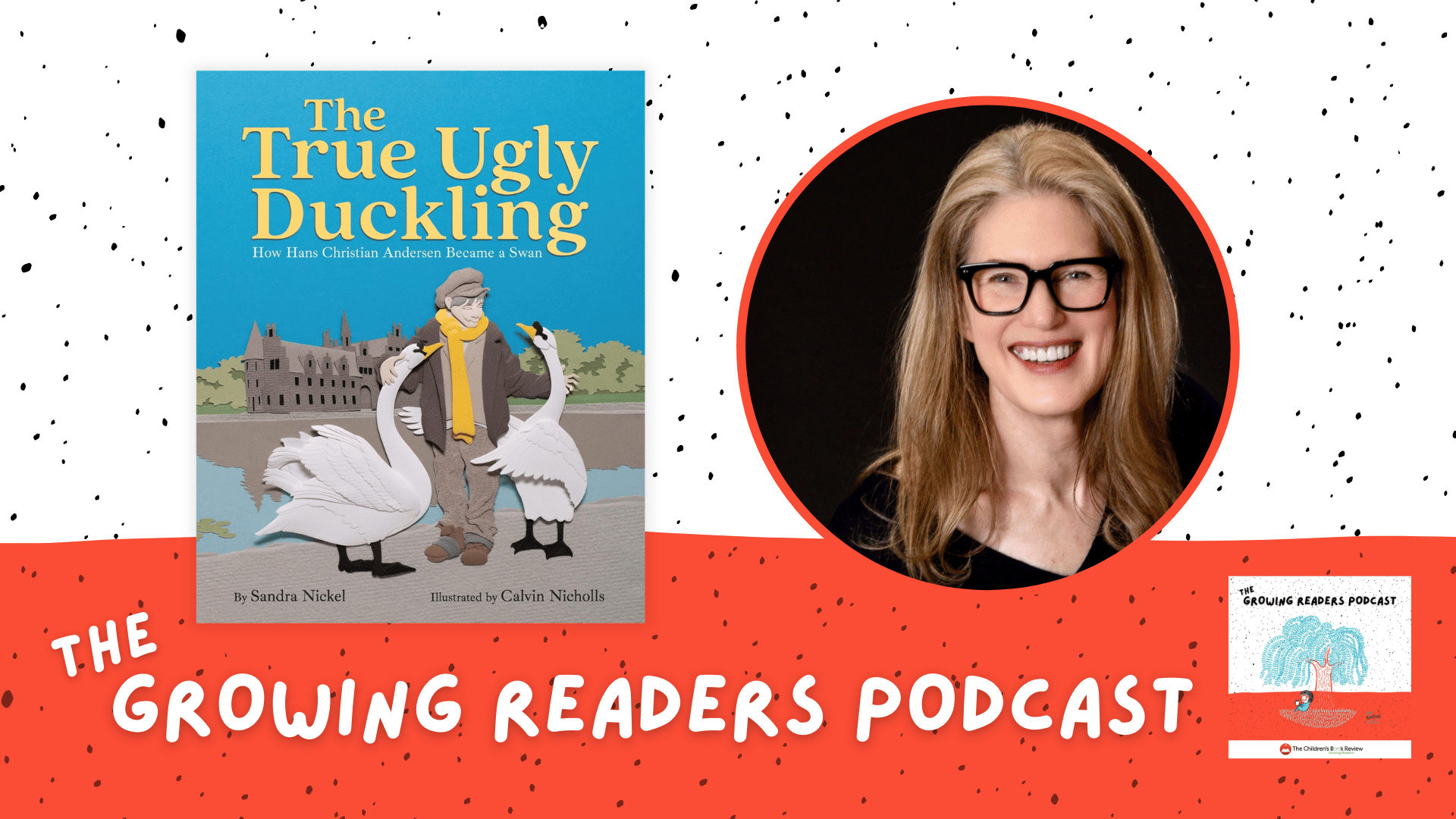
A podcast interview with Sandra Nickel discussing The True Ugly Duckling: How Hans Christian Andersen Became a Swan on The Growing Readers Podcast, a production of The Children’s Book Review.
In The True Ugly Duckling: How Hans Christian Andersen Became a Swan, author Sandra Nickel offers a fairy-tale-like portrait of how a misunderstood child grew into one of the world’s most beloved storytellers.
He was called strange. He didn’t look right, think right, or fit in anywhere. Even his own mother said so. But Hans Christian Andersen took every rejection, every slammed door, every moment of feeling like too much—and turned it into stories that children around the world are still reading two centuries later.
In this episode, author Sandra Nickel talks about her luminous picture-book biography, The True Ugly Duckling, why she structured it as a fairy tale, and what she most hopes the child who feels different will take away from Andersen’s remarkable life.
For every kid who has ever been told they’re too much—this one’s for you.
Subscribe to The Growing Readers Podcast to ensure you never miss an episode celebrating the creators shaping young readers’ lives.
Listen to the Episode
The Show Notes
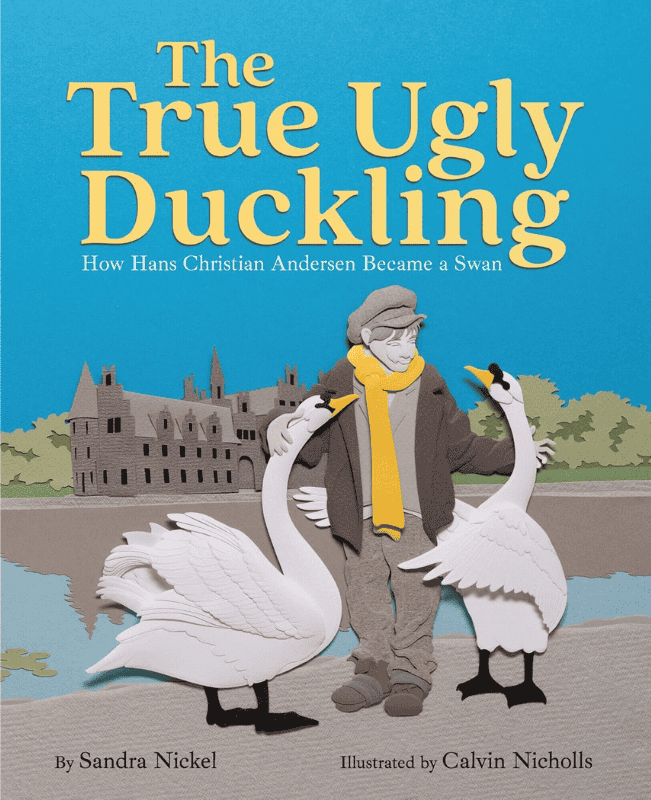
The True Ugly Duckling: How Hans Christian Andersen Became a Swan
Written by Sandra Nickel
Illustrated by Calvin Nicholls
Ages: 4-8 | 32 Pages
Publisher: Levine Querido | ISBN-13: 978-1646145768
Publisher’s Summary: Picture book biography of one of the most iconic storytellers of all time, Hans Christian Andersen, illustrated by papercut artist Calvin Nicholls.
He brought to life stories and characters that millions have loved: A one-legged tin soldier who yearned for love. A poor little match girl. A mermaid who gave up her voice for a prince. But who was Hans Christian Andersen? He was a “strange child.” An ugly duckling. Even his mother said so. He didn’t seem to think like, or look like, anyone around him. But while his tender heart was bruised by ridicule, it responded by driving an unstoppable urge to create, to entertain. If he couldn’t act, he would dance, if he couldn’t dance, he would sing, and if he couldn’t sing … well, maybe he had stories to tell. With each rejection and defeat, Hans would soothe himself by making art with scissors and whatever was handy. A bit of cloth, a piece of paper. Until one day…
Structured like a fairy tale, this is the story of how Hans Christian Andersen took all the parts of his life—whether painful or transcendent—and used them to create books that have touched children the world over.
This is the first picture book biography of Andersen to be told through a lens that takes into account what scholars now know of his neurodiversity. Anderson, for instance, often told stories while keeping his hands busy by making paper-cut art. In this spirit, the remarkable illustrations by Calvin Nicholls are all created as paper-cut soft sculptures.
A fresh and uniquely beautiful look at one of the world’s greatest storytellers.
Buy the Book
About the Author
Sandra Nickel is an award-winning author of picture books. She is honored to be the winner of a Christopher Award, a two-time winner of the Society of Children’s Book Writers & Illustrators Crystal Kite Award, a finalist for the Golden Kite Award for Nonfiction for Younger Readers, a Junior Library Guild Gold Selection honoree, and a Charlotte Huck Award Recommended author. She holds an MFA in Writing for Children and Young Adults and has presented workshops on writing for children and young adults throughout Europe and the United States.
To learn more, visit sandranickel.com.
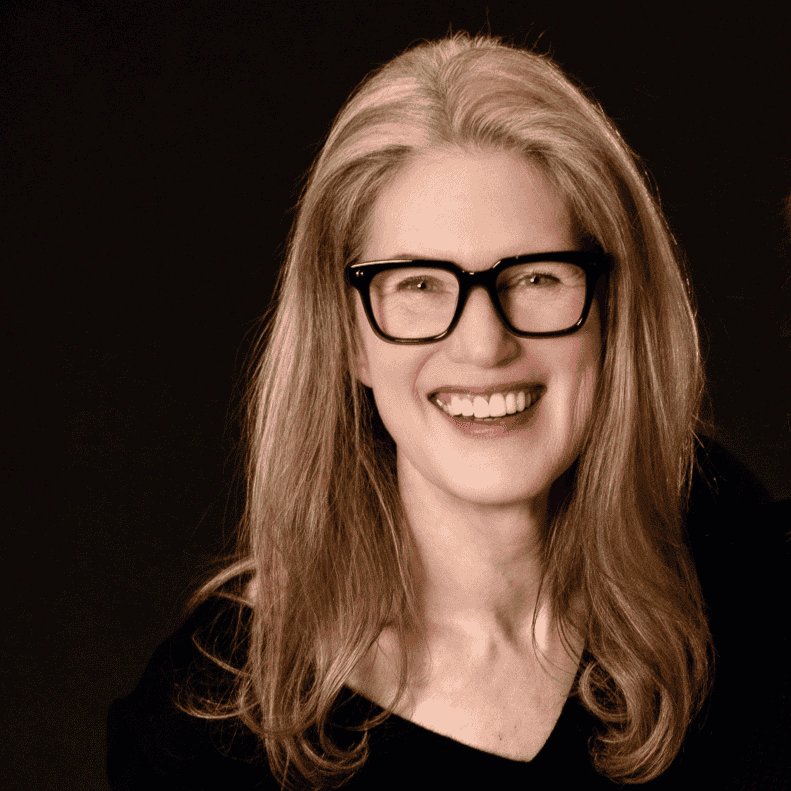
Credits:
Host: Bianca Schulze
Guest: Sandra Nickel
Producer: Bianca Schulze
Read the Transcript
Bianca Schulze: Hi, Sandra. Welcome to The Growing Readers Podcast.
Sandra Nickel: Hi, Bianca. It’s great to be here.
Bianca Schulze: I am hoping that we can just warm up our conversation with a couple of rapid-fire questions. Is that okay with you?
Sandra Nickel: Well, yes, let’s try it.
Bianca Schulze: All right. Are you a dog person or a cat person?
Sandra Nickel: I’m a both person. I have both a cat and a dog.
Bianca Schulze: I love it. What kind of dog do you have?
Sandra Nickel: An Australian Shepherd. Mine’s a tri — black, beige, and white.
Bianca Schulze: Me too! Mine’s a mini, though. What colors is yours?
Sandra Nickel: That’s perfect. Mine’s a mini too! What’s her name?
Bianca Schulze: Poppy, like the flower.
Sandra Nickel: Ours is Haley, because she was born in an H year.
Bianca Schulze: I love it. All right, next rapid-fire question. The last thing that made you stop and stare.
Sandra Nickel: Goodness. I can’t think of anything.
Bianca Schulze: This question just made you stop and stare — I love it! All right. Silence or music while you write?
Sandra Nickel: Complete silence.
Bianca Schulze: Yes. If I have music while I’m writing, it has to be wordless — no lyrics.
Sandra Nickel: Yeah, maybe I could do that. Actually, no, because my brain just always goes to the music. If I have music on, I’m not getting any writing done.
Bianca Schulze: Yeah, I understand that completely. Do you prefer a happy ending or a bittersweet ending to a story?
Sandra Nickel: Happy, happy, happy.
Bianca Schulze: And if you had to pick just one, would you pick fairy tales or biographies?
Sandra Nickel: Fairy tales.
Bianca Schulze: Do you have a favorite fairy tale from your childhood?
Sandra Nickel: I think, actually, so many of Hans Christian Andersen’s — even though some of them are pretty scary. Maybe “The Princess and the Pea.” There was always that great hope that you would be the one who was wonderfully different and still get the happy ending.
Bianca Schulze: Yes! I think “The Princess and the Pea” was my favorite too, although I always felt sorely disappointed that I couldn’t possibly be the princess, because I could sleep through everything.
Sandra Nickel: Well, you never know. Did you ever try a pea?
Bianca Schulze: I mean, I didn’t like peas as a kid, so I probably never even thought to try it.
Sandra Nickel: You might have woken up all black and blue and realized — it’s me!
Bianca Schulze: Exactly! All right. Longer responses now. They say that to be a writer, you need to be a reader first. Was there a pivotal moment in which you considered yourself a reader?
Sandra Nickel: Well, I think I was always a reader — that was my lifeline. I read all the time. But when I went and got my MFA in Writing for Children and Young Adults, I learned how to be a writer who reads. A writer who reads isn’t just enjoying the book or losing themselves in it. There’s this little Sandra constantly watching, thinking, “Oh, that’s how they did that. Oh, what a great way to do that. Oh, let me stop and make a note on this.” I actually do this with movies too, and it drives my daughter insane — I’ll be like, “Do you see what they just did there? Do you see how they did that?” So yes, it’s a very different way to be a reader.
Bianca Schulze: Well, on that note — the question I had before was about the last moment that made you stop and stare. Now I’m going to put you on the spot again. What was the last book or movie where you had that moment of, “Yes, that’s how they did it. That’s so clever”?
Sandra Nickel: I recently read Kate Hosford’s You and I Are Stars — I hope I’m not butchering the title, she’s one of my good friends. It’s an “I love you” book, and she has such a wonderful facility for finding fresh ways to express the love between a parent and a child. I just loved reading it. She had such original ways of bringing out that emotion.
Bianca Schulze: That is a beautiful book, and I believe you got the title right — I should know, because I just published a written interview with her on The Children’s Book Review. But yes, it’s a beautiful book. Now, is it true that after you received your MFA, you drove so hard toward finishing a middle grade novel that the joy of writing disappeared — and you actually stopped for a period of time?
Sandra Nickel: Yes, that’s true. I pushed so hard toward a goal that I lost sight of why I was writing in the first place. The joy just drained out of it, and I had to step away and find my way back.
Bianca Schulze: And how did you find your way back?
Sandra Nickel: Picture books, actually. I started playing with picture books — shorter, more contained — and the playfulness came back. It reminded me that writing is supposed to feel like something. And from there, I could return to longer work with a healthier relationship to it.
Bianca Schulze: I love that. It’s like the picture book saved you.
Sandra Nickel: It really did.
Bianca Schulze: So let’s talk about The True Ugly Duckling. What was the seed of this book for you? Where did it begin?
Sandra Nickel: Well, I have a personal connection to neurodivergence. And I kept thinking about Hans Christian Andersen and wondering — was he neurodivergent? Because so many of the things written about him, the way people described him, the way he moved through the world — it just resonated so deeply with me. And I thought, what a gift it would be for a child who feels different to know that this man, who gave us some of the most beloved stories in the world, felt exactly like that too.
Bianca Schulze: That is such a powerful origin for the book. And I think that personal connection really comes through on the page. The book feels so tender — not like a history lesson at all.
Sandra Nickel: That was everything to me. I didn’t want children to feel the distance of history. I wanted them to feel, “This is me. This person is me.”
Bianca Schulze: And you made a very deliberate choice to write this as a child — Andersen as a child, seen through a child’s eyes, in a way that almost mirrors his own fairy tales in structure. Can you talk about that?
Sandra Nickel: Yes. I knew early on that I wanted to write it structured like a fairy tale, because fairy tales do something very particular. They come from the heart, and they open the heart. But they also give distance. In a fairy tale, quite terrible things can happen, and children absorb them without being traumatized — because there’s something about the fairy tale container that lets us process hard things safely. I wanted that for Andersen’s story, because some of what happened to him was genuinely painful. Cruelty. Rejection. Humiliation. If I wrote it in a contemporary, realistic way, it could feel traumatic. But inside a fairy tale, children can hold it.
Bianca Schulze: That is so beautifully said. It’s like Hansel and Gretel getting shoved into an oven — and children just take it in stride.
Sandra Nickel: Exactly! And yet they still connect to the yearning in those stories. The yearning to be loved. The yearning to belong. That’s what fairy tales carry so well.
Bianca Schulze: You’ve spoken about writing this book for children who feel different — not only autistic children, but any child who hasn’t been diagnosed, may never be diagnosed, and is simply walking around feeling like they’re too much for everybody. How do you write toward a reader you can’t quite define?
Sandra Nickel: I always have a vision of a child as I’m writing — some sense of who is out there waiting for this story. But as you say, you never really know who it’s going to reach. So in the end, you write from your heart. And when you write from your heart, especially through a fairy tale, my hope is that it goes straight to the heart of the child who most needs it.
Bianca Schulze: There’s a spread near the end with the line, “Now that he had started, the shoemaker’s son couldn’t stop.” What does that moment represent to you — both for Andersen and for the children reading it?
Sandra Nickel: For me, it’s that moment of finally knowing who you are and where you’re going. Andersen tried for so long, and so many doors were shut in his face. But by that point, he had all the tools he needed, and something was released in him. It’s like the ugly duckling looking into the stream and seeing his reflection — and realizing, “Wait. I’m a swan.”
Bianca Schulze: If a parent or educator is listening right now, and they have a child in their life who masks or feels like an outsider or doesn’t understand why they’re different — what do you most want to say to that adult about handing them this book?
Sandra Nickel: Read it with gentleness, and love, and encouragement, and hope. I grew up thinking there was no one like me, and that is a hard way to grow up — especially if you’re masking so much that you can’t even see that there might be others like you. So if they can take this book and show a child that the very things they’re using to cope, the things that make them different, could actually be their way forward — isn’t that a remarkable thing?
Bianca Schulze: Yes. I think my favorite idea in all of this is that when we want something so badly for ourselves — and the world keeps telling us no — so many people start listening to the outside instead of the inside. But those who keep listening to their inner voice, who keep going even when it’s hard, they eventually find a way. It may not look exactly like what they imagined. But I think this book shows that when you persevere and follow your true self, you will find your way.
Sandra Nickel: So well said, Bianca. Andersen imagined first that he’d be an actor. But he just had this heart that knew the direction, and he kept reinterpreting what that direction was — until he finally found it.
Bianca Schulze: And how incredible that so far into the future, we still know his stories. Our children know his stories. Their children will know his stories. He would have had no idea he was building such a lasting legacy — and yet he was. And that, too, is such a fairy tale ending.
Sandra Nickel: It truly is the fairy tale ending. And one of the things I love most about his story is that it was always the adults who were shutting the door on him. Even when he first wrote his fairy tales, the adults thought they were strange. But it was the children who loved them. It was children — with their big, open hearts — who allowed him to keep going.
Bianca Schulze: Sandra, is there anything we haven’t covered that you’d love listeners to know?
Sandra Nickel: I think we’ve touched on everything. But I would love to say just a little about Seven, A Remarkable Pigeon, because in my mind the two books are so deeply linked — I wrote them at the same time. In Seven, you have a pigeon who uses his differentness — his extraordinary sense of smell — to become a hero. It’s the same arc as Hans Christian Andersen’s story. He used his love of story to become a hero. And I really want children, teachers, and parents to know: when a neurodivergent child becomes very focused on something they love, something that brings them deep joy — give them grace to pursue it. Who knows where that joy might take them?
Bianca Schulze: Beautiful. So tell us a little more about Seven, A Remarkable Pigeon — what inspired it?
Sandra Nickel: Seven was inspired by my daughter’s journey. She finds joy in so many things that other people just walk right past without noticing. And so there is Seven, with his extraordinary sense of smell, not fitting in with what the flock is supposed to be doing — because he’s busy savoring the beautiful smells of the world. But in the end, they needed him, and he was there.
Bianca Schulze: I love it. It sounds like those two books truly belong together.
Sandra Nickel: They will always be linked for me — because of how they were created, and because of what they share at their heart.
Bianca Schulze: Sandra, this conversation will stay with me — especially the idea that what made Hans Christian Andersen seem possibly strange is exactly what made him extraordinary. Thank you for writing a book that says that out loud, for the children who need to hear it most. And thank you so much for joining us on The Growing Readers Podcast today.
Sandra Nickel: It was such a joy being here, Bianca. Thank you so much.
Bianca Schulze: It was my pleasure.
